OUR HERITAGE
The story of Seiko began in 1881, when a 22 year old entrepreneur, Kintaro Hattori, opened a shop selling and repairing watches and clocks in central Tokyo.
Today, after more than 130 years of innovation, Kintaro Hattori’s company is still dedicated to the perfection that the founder always strove to achieve.
1881 — 1899 milestones
1881
Kintaro Hattori opens a shop selling and repairing watches and clocks in Ginza, Tokyo
The story of Seiko began in 1881, when a 22 year old entrepreneur, Kintaro Hattori, opened a shop selling and repairing watches and clocks in central Tokyo. Just eleven years later, in 1892, he established the ‘Seikosha’ factory.
1892
Seikosha was founded; started producing wall clocks
In 1892 Kintaro Hattori bought a disused factory in Tokyo and Seikosha was formed (In Japanese, “Seiko” means “exquisite”, “minute” or “success” and “sha” means house). It was here that Kintaro Hattori produced his first clocks and these marked the beginnings of a company that was to become one of the world’s most important manufacturers of timepieces.
1895
Seikosha builds the first pocket watch
Throughout the 1890’s, the success of Seikosha’s wall clock business increased, and Kintaro looked to broaden the range of his business. In 1895, he created a pocket watch, the Timekeeper. It was a vital step forward, without which the future of Seiko would have been very different as it paved the way for Japan’s first ever wrist watch.
1900 — 1949 milestones
1913
The Laurel, the first wristwatch made in Japan, makes its debut
In the beginning of the Taisho Era, pocket watches were still very popular and there were only a few wristwatches imported to Japan. Kintaro, however, was determined to be ‘one step ahead’ and embarked on the arduous task of creating Japan’s first ever wristwatch. In 1913, he succeeded and the Laurel was produced. In the early days, the company was able to produce only 30 to 50 watches a day, but, for the first time, Kintaro had established a lead on the rest.
1924
The first Seiko brand watch was produced
In 1923, the Great Kanto Earthquake struck and the company’s headquarters and the Seikosha factory all burned down. A fresh start had to be made. Just after the Earthquake, the company had created an entirely new watch and it went on sale in December 1923. It was the first to carry the name Seiko, introducing to the world for the first time the brand name that was later to become synonymous with precision and accuracy, innovation and refinement.
1929
Seiko pocket watch is appointed as Japan National Railway’s official “railway watch”
As its railway network expanded, Japan National Railways appointed Seiko as its official supplier. Train drivers often made wooden cut-outs on their consoles where the approved pocket watch would sit in line of sight as they drove their trains.
1932
Constructed the Wako Clock Tower, the familiar face of Ginza
The current clock tower was constructed in 1932. The building adopts a style called neo-renaissance.
1950 — 1959 milestones
1956
Started to use “Diashock”, a shock-resistance device
Diashock is a shock-resistance device. When a watch is subject to shock, as when it is dropped on a hard floor, the component most likely to be damaged is the balance-staff pivot, which is the balance wheel’s rotation axis. Even compared to other movement parts, this part is extremely thin, being only between 0.07 to 0.08mm in diameter, or about the same as a human hair. Protection from shock is therefore crucial and the Seiko solution was to create Diashock, a device that absorbs impact on one of the most vulnerable parts of the mechanical watch, the balance-staff pivot. Diashock also reduces friction to ensure optimum amplitude of the balance wheel.
1959
Gyro Marvel
This is the first self-winding watch equipped with Seiko’s proprietary “magic lever” system. The magic lever is an innovative self-winding mechanism that uses the simple “claw lever system” efficiently to transmit the power of the oscillating weight in both directions. Magic levers are still used in SEIKO’s self-winding watches on the market today. This low-cost mechanism with excellent winding quality instantly dominated the world market, pioneering the popularization of self-winding watches.
1960 — 1969 milestones
1964
Introduced Japan’s first wristwatch equipped with a stopwatch
Japan’s first wristwatch equipped with a stopwatch, introduced in 1964, the year of the Tokyo Olympic Games. Its smooth operation and durability were ensured by a column wheel.
1965
Produced the first Japanese diver’s watch
The first Japan-made diver’s watch, waterproof to a depth of 150 meters. The winding crown was designed with a double packing structure to withstand high water pressure. Designated for use by the 8th Japanese Antarctic Research Expedition.
1967
Neuchatel Observatory Competition and Geneva Observatory Competition
In 1967, Daini Seikosha sent to Neuchatel caliber 45 movements that were being used in the Grand Seiko and King Seiko lines, and these were subsequently marketed as special pieces that has passed the tests for “specially calibrated timepieces”. They were known as the Observatory Chronometers and these VFA Seiko watches took second and third places in the chronometer competition. This was the last year of the Neuchatel competition held under the old rules.
Seiko then entered the Geneva Observatory competitions and at the very first attempt achieved a fantastic result. Seiko’s entries were awarded every place from fourth to tenth, which was the best result achieved by any manufacturer of mechanical wristwatches. Seiko achieved first place overall.
1969
Introduction of cal. 6139, the world’s first automatic chronograph watch equipped with both vertical clutch and column wheel
As the world’s first automatic chronograph with a ‘magic lever’, column wheel and vertical clutch, this may have been the world’s first such timepiece, and it was a milestone in Seiko’s journey toward pre-eminence in chronograph technology.
1969
Introduction of the world’s first quartz watch, “Seiko Quartz Astron”
The world’s first quartz watch, the Seiko Quartz Astron was introduced in Tokyo on December 25, 1969. It delivered unmatched performance. It was accurate to within 5 seconds per month, 100 times more accurate than any other watch, and it ran continuously for a year, or 250 times longer than most mechanical watches. The quartz revolution had begun.
1970 — 1979 milestones
1973
Introduction of the world’s first six-digit LCD quartz watch cal. 0614
This fully-electronic watch used the world’s first six-digit liquid-crystal display to indicate the time. Capable of continuously displaying the hour, minutes and seconds on a field-effect liquid crystal display, this groundbreaking digital watch attracted wide attention when it was first marketed in October 1973. The internally developed LCD was long-lived (50,000 hours) and had good contrast. A lamp provided enough illumination to make the numbers on the display easy to read even in the dark.
1975
Introduction of the world’s first multi-function digital watch cal. 0634
In 1975 Seiko launched the world’s first digital quartz watch with a chronograph, the 0634. It could record time to 1/10 of a second and had a lap time function. It also incorporated an internal light, so that it could be seen clearly in the dark. It became a huge hit and created the market for high-function digital watches.
1975
Introduction of the world’s first diver’s watch with titanium case, the Professional Diver’s 600m
One day in 1968, Seiko’s engineers received a letter from a professional diver from Hiroshima Prefecture. The letter shocked Seiko’s engineers with its vivid description of the stresses and strains put on a watch by professional saturation divers who dive to depths of 350 meters. Seiko took up the challenge. After seven years of research, the Professional Diver’s 600m, the world’s first diver’s watch with titanium case, was created.
A gasket impervious to helium, legible at great depths and with a titanium case. It set a new standard for diver’s watches.
1980 — 1989 milestones
1982
Introduced the world’s first TV watch
The world’s first watch designed with both a tuner and headphone jack for watching TV at any time or place. Also equipped with an FM radio, together with all of the standard watch functions such as alarm, chronograph, and calendar.
1983
The world’s first voice recording watch, “Voice Note”
Since 1973 when introduced world’s first six-digit LCD quartz watch, Seiko had developed wearable information devices. ‘Voice Note’ is the world’s first watch equipped with a voice recording function. The sound for maximum 8 seconds can be recorded and played as a voice memo. It also plays a voice alert at the setting time.
1983
Introduction of the world’s first analog quartz watch with chronograph
Seiko’s mastery of quartz technology and of mechanical chronograph watchmaking came together in the creation of the world’s first analog quartz chronograph. It measured elapsed time to 5/100 second and offered split time capability and a tachymeter. It was designed by the celebrated Italian car designer, Giorgetto Giugiaro.
1984
Introduction of the world’s first watch with computer functions, UC-2000
1986
The world’s first Diver’s 1000m with a ceramic outer case
The Diver’s 1000m was the first watch to use ceramic material for the outer case layer. The lightweight, corrosion resistant titanium case with a remarkable one-piece structure enabled this watch to withstand depths of 1,000 m.
1987
Served as official timer of the IAAF World Championships in Rome, Italy
Seiko serves as Official Timer at the 2nd IAAF World Athletic Championships in Rome, Italy.
1988
Introduction of the world’s first “A.G.S.” watch cal. 7M22 (later renamed as “Kinetic”)
From the moment that the quartz watch was born, Seiko strove to create ‘no battery change’ technologies. In 1977, Seiko introduced the solar powered watch and, in 1986, a quartz watch with hand winding generating system. In 1988 came the big breakthrough; Seiko KINETIC, a watch with an oscillating weight that converted the wearer’s motion into electricity and thus powered the quartz movement.
1990 — 1999 milestones
1990
Introduction of the world’s first computerized diver’s watch, “Scubamaster”, cal. M726 with dive table and depth meter functions
1991
Served as official timer of the IAAF World Championships in Tokyo, Japan
Seiko serves as the Official Timer at the 3rd IAAF World Athletic Championships in Tokyo, Japan.
1993
Served as official timer of the IAAF World Championships in Stuttgart, Germany
Seiko serves as the Official Timer at the 4th IAAF World Athletic Championships in Stuttgart, Germany.
1999
Introduction of the Ultimate Kinetic Chronograph cal. 9T82
Seiko’s successful Kinetic watch was equipped with stopwatch function in a very unique design. It is equipped with zero resetting function using heart shaped cam and special movement construction that avoids dusts.
2000 — 2009 milestones
2005
Introduction of the world’s first three-band (Japan, Germany, US) radio wave analog solar watch
Seiko commercialized solar powered radio-controlled analog watches capable of receiving the standard wave of three countries (Japan, US and Germany), the first device of its type.
2005
Introduction of the Kinetic Perpetual
Powered by the motion of your body, it is the first watch to generate and save its own electricity. It goes to sleep when not worn and the hands return automatically to the correct time when put on again. The perpetual calendar will be correct until February 28, 2100.
2006
Introduction of the world’s first E-Ink watch
2006
Introduction of Credor Spring Drive Sonnerie
Only Spring Drive presents the true natural and continuous flow of time, with no ‘tick’ as the hands move in perfect glide-motion. Only Spring Drive is so silent that time can be marked by the long, lingering chime of the Japanese Orin bell.
2007
Introduction of the Spring Drive Chronograph
2010 — 2019 milestones
2010
Introduction of Seiko Spring Drive Spacewalk Commemorative Edition
This watch was designed specifically for a spacewalk. Both inside and outside the International Space Station, it performed flawlessly in space. It won the sports watch award of Grand Prix d’Horlogerie de Genève.
2010
The world’s first EPD watch with an active matrix system
This new display system retains all the legibility benefits of Seiko’s first E-Ink watch, but allows for a much richer range of imagery and data to be displayed on the watch dial with 80,000 pixels, each capable of four different shades, delivering 300 dpi of display.
2012
Introduction of the world’s first GPS solar watch, Seiko Astron GPS Solar
At last, the search for totally precise time, everywhere on the planet, is over. By developing our own, patented, low-energy-consumption GPS receiver, Seiko has been able to create a watch that can receive GPS signals and identify time zone, time and date data using the global network of GPS satellites. It recognizes all the 39 time zones on earth. This breakthrough timepiece is called Seiko Astron.
Like its celebrated 1969 predecessor which was the world’s first quartz watch, the new Seiko Astron ushers in a new age of timekeeping technology.
2013
100th anniversary of Seiko watchmaking
When, in 1913, Seiko built its first wrist watch, the company’s president called it the Laurel. It was not only a first for Seiko, but also a first for Japan and it was the beginning of a tradition of innovation that resulted directly from Kintaro Hattori’s determination that Seiko would always be “one step ahead of the rest”.
2013
Special edition timepiece to commemorate the centennial anniversary
A special edition timepiece was introduced for the Seiko Astron collection. Commemorating the 100th anniversary of Seiko watchmaking, the limited edition piece was the first to be named after the founder, Kintaro Hattori.
2014
The Seiko Astron GPS Solar 8X Series Chronograph. The Astron revolution gathers pace
Since its first appearance in 2012, Astron has proven to be a stunning success worldwide. In 2014, the second-generation creation powered by Caliber 8X was introduced. It offered enhanced performance and a more compact design, which made possible a wide range of new designs and colors.
2017
Grand Seiko becomes an independent brand
2019
Credor becomes fully independent on its 45th anniversary
2019 marked the 45th anniversary of Credor’s founding, and in this milestone year, Credor became independent from the Seiko brand, establishing itself as the second pillar of the company’s luxury watch offerings alongside Grand Seiko.
2019
Seiko Prospex is awarded at the Grand Prix d'Horlogerie de Genéve for the second consecutive year
The SNR029 from the LX Line collection of Prospex won the Diver’s Watch Prize at the 2019 Grand Prix d’Horlogerie de Genève.
This marks the second consecutive year that a creation from the Prospex collection won an award, following the 2018 win in the “Sports” watch category for the Marinemaster Professional 1968 Automatic Diver’s Re-creation.
2020 — milestones
2020
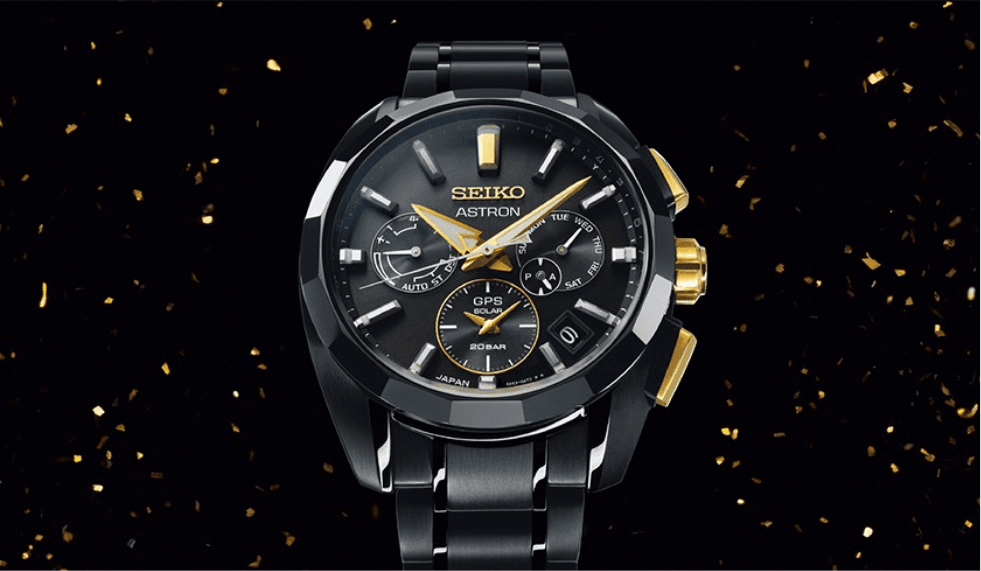
Seiko Astron releases a limited edition model commemorating the 160th anniversary of the birth of its founder, Kintaro Hattori
Seiko Astron releases a limited edition model commemorating the 160th anniversary of the birth of Seiko’s founder, Kintaro Hattori.
The model commemorating the founder is designed with a dignified and imposing appearance, featuring a predominantly black and gold color scheme. The bezel is made of zirconia ceramics, which is hard and highly scratch-resistant, and features a 16-facet cut in honor of the 160th anniversary.
2021
Seiko 140th anniversary
“Always one step ahead of the rest.” This was Kintaro Hattori’s guiding philosophy for the company he founded in 1881. It has shaped the company for more than a century of innovation.
This principle, as well as the desire to appeal to customers’ emotions, is reflected in our Group slogan.
“Moving ahead. Touching hearts.”
2021
Seiko Prospex introduces a new Speedtimer series
In 2021, a new Speedtimer series was introduced into the Prospex collection in honor of Seiko’s rich and continuing tradition of sports timing.
2022
Relaunch of King Seiko
Originally born in 1961, King Seiko was revived in 2022. For the relaunch, the second-generation model known as the “KSK” served as the foundation for development. It was highly regarded for its practical advancements, including water resistance and use of a hacking seconds hand. With its sharply defined case with prominent edges, and box-shaped glass, this model played a key role in establishing the distinctive design language of King Seiko.
2024
The Seiko Brand 100th Anniversary
Since the beginning of the company’s foundation in 1881, Seiko has continued to innovate in line with the founder’s philosophy to be “Always one step ahead of the rest.”
In 1924, the company introduced the first wristwatch with “Seiko” on the dial, signifying the beginning of the Seiko brand. The year 2024 marked the 100th anniversary of this landmark event.